Category: Nail Ideas

Explore the most popular nail ideas in Reading, from seasonal colours to elegant wedding nails, minimalist styles, French manicures and creative nail art. At Rachel’s Nails Reading, we follow the latest nail trends our local clients love. Whether you want short nails for work, bold colours for summer, or classy designs for special occasions, this is where Reading clients find inspiration before booking their appointment.

  • How To Take Off Fake Nails: 2 Easy Ways That Everyone Can Do

    How To Take Off Fake Nails: 2 Easy Ways That Everyone Can Do

    False nails look wonderful, but they might be difficult to remove if you haven’t done it before. You may either go to a salon or do it yourself at home to remove the nail adhesive. After soaking your nails in soapy water, carefully file them off if you have glue-on nails or tips.

    Then, using a nail buffer and acetone, remove any remaining adhesive. To glued-on nails, just use acetone and file away any leftover gluey residue. After that, you’ll have natural nails that are strong and healthy.

    How To Take Off Fake Nails: 2 Easy Ways That Everyone Can Do

    How to take off fake nails without using acetone

    Soak your nails for 15 minutes in warm, soapy water. Fill a bowl or sink basin halfway with warm water and a little amount of mild hand soap. Place your hands in the bowl or basin so that your glue-on nails are completely immersed, and let them there for about 15 minutes.

    Soap and water will seep into the nail adhesive and soften it, making the nails simpler to remove.

    To soften the glue, soak your nails in a little pure acetone, but keep in mind that acetone is considerably harder on your skin, nails, and cuticles than soap and water.

    Alternatively, soften your nail adhesive by smearing a few drops of cuticle oil on each fake nail and allowing it to soak in for a few seconds.

    Once the adhesive has loosened, gently pry the artificial nails off. Look for a location where the nail has already begun to detach and gently pull the nail out from there. If you can’t find a loose area, gently work the tip of a nail file beneath the fake nail’s edges to loosen it.

    If the nail does not come out easily, do not try to rip it off. If you need to soften the glue a few more minutes, soak the nail in soapy water for a few minutes longer.

    Excess glued nails should be gently filed away using a nail buffer. Once the artificial nails have been removed and your natural nails have dried slightly, use the “buff” side of a nail buffer block to buff away the majority of the adhesive. When you’re confident that you’ve eliminated the majority of the adhesive, rinse the powder away with water.

    After buffing your nails, you may use the “shine” side of the buffer to polish them.

    Using acetone, remove any residual glue. To remove any remaining traces of nail glue, soak a cotton ball in acetone and massage it on each fingernail. Wash your hands with soap and water to remove any acetone residue from your hands and nails.

    Apply a little amount of nail moisturizer or cuticle oil if your nails feel dry after rubbing them with acetone.

    How to take off fake nails with an acetone soak

    Cut your fake nails as short as possible. Acrylic nails are composed of materials that attach directly to your natural nails rather than being glued on. Trim the artificial nails to a short but comfortable length using a pair of nail scissors or clippers, taking care not to cut any of your real nails. Because there would be less debris to dissolve, the remainder of the removal process will be sped up.

    Trimming down into your nail bed will be unpleasant.

    This method is applicable to both SNS (dipping powder nails) and acrylic nails.

    Remove the fake nail’s shiny surface using a file. If the artificial nails are still connected to your natural nails, remove the glossy surface using a nail file. Back and forth across your nails with the file until the shiny sheen is gone and the nails look matte. Make an effort to massage each area of the nail equally. This will expedite and improve the removal procedure.

    Stop filing that place if you notice any of your natural nails showing through under the artificial nails. You risk harming your natural nails if you continue to file.

    Wipe any dust away with a clean, dry cloth or cotton pad. A microfiber cloth is a cheap and effective alternative, but any clean cloth will do. Remove any dust from your nails to allow the acetone to more easily penetrate the leftover acrylic.

    Apply petroleum jelly or oil cuticles to the area of skin surrounding your nails. This will shield your skin from the acetone. Apply a small coating to your nail beds as well as the skin underneath and around your nails.

    Apply petroleum jelly or oil cuticles if you have dry or sensitive skin.

    Wrap a cotton ball soaked in acetone around each nail on one hand. If you have acetone in a dripper container, carefully squeeze it onto the cotton pads. If the acetone is in a normal container, pour it into a small disposable dish before dipping the cotton pads into it. Each wet cotton pad should be placed over one of your nails.

    Cotton balls can be used instead of cotton pads if you don’t have any.

    Acetone and cotton pads can be purchased at a pharmacy or a supermarket. If you have sensitive skin, use an acetone-based nail paint remover that is specially formulated for it.

    Acetone fumes may be hazardous, therefore always use it in well-ventilated places.

    Wrap an aluminum foil strip around each nail and cotton pad. Tear out a piece of aluminum foil about 1 inch (2.5 cm) by 2 inches (5.1 cm). Make sure the cotton pad is in place before wrapping the foil around the nail and cotton pad.

    The metal foil will help to retain heat and moisture, preventing the acetone from evaporating before the glue has a chance to soften. This expedites the removal procedure.

    Repeat the technique for all of the nails on one hand before moving on to the other. If you find it difficult to work on your opposite hand while your other hand is still soaking, look for the assistance of a friend or wait until the foil and cotton pads have been removed before attempting to begin the second hand.

    After 20 minutes, remove the foil and pads. Set a timer for 20 minutes and allow the acetone to do its thing. Remove the cotton pads from the foil that has been wrapped around your nails. You should see that the adhesive has dissolved and the fake nails have softened.

    Leave the foil and pads on for another 15 minutes if the first nail is still coated in adhesive or the artificial nails are still securely in place.

    Avoid putting used acetone pads on wooden or plastic surfaces because the chemicals will harm the surface.

    With a tea towel, remove the spongy fake nails. Clean the dissolved debris from the fake nails with a clean dish towel. Apply pressure to the tea towel when cleaning the nails, but stop if your natural nails begin to hurt.

    If the fake nails do not come out easily, replace the acetone-soaked cotton balls and foil.

    Buff away any extra glue or paint with a nail file. Don’t be concerned about filing your entire nail. Instead, concentrate on the places where there are glue residues. You don’t want to file your natural nails, so try not to push too hard.

    A nail file may be purchased from a drugstore. It’s worth noting that some retailers will refer to them as nail buffers.

    How to treat your nails after taking off fake nails

    Hands should be washed with warm, soapy water. If you leave acetone on your skin, it will dry it out, so wash it off with warm water and natural soap. A natural soap will aid in the retention of your skin’s natural oils.

    If you just have normal soap at home, use that.

    Removing nail adhesive from your nails might cause your hands to get dry. To restore the natural moisture of your nails, cuticles, and hands, rub natural oil freely over them.

    Natural nail moisturizers such as almond oil and olive oil are effective. These may be purchased from a natural health and beauty store or a drugstore.

    Allow your nails to rest in between manicures. If you often use artificial nails, your real nails will benefit from a rest between treatments. After removing the fake nails, let your natural nails a few days to a week to heal before applying new false nails or paint.

    Try taking a week off between manicures every 8 weeks.

    Consider putting fake nails without adhesive the next time to see if it works better for you than having to remove nail glue.

    Frequently asked questions about how to take off fake nails

    Q: How do you get rid of remaining nail glue?

    A: Clumps of nail adhesive can be removed by buffing. Acetone can be used to eliminate small quantities of residue.

    Q: If I don’t want to use acetone, how can I remove the glue off my nails?

    A: If you don’t want to soak your nail tips in acetone, you can carefully file the glued-nails away.

    Q: No matter how hard I try, I can’t get my artificial nails off, and I’m too busy to go to a nail parlor. What am I supposed to do?

    A: Apply pure acetone to cotton balls, apply a wet cotton ball to the nail, and press it firmly against the acrylic, on the area where it has stuck to your natural nail, using tin foil to keep it in place (this prevents you from having to handle the acetone a lot). Use tin foil to retain an acetone-soaked cotton ball or two on each nail while the acetone eats away at the acrylic nail and adhesive. If you can not do it by yourself at home, you should go to the nail salon so that the manicurists can help you with this process.

    Summary

    That’s all there is to it when it comes to how to take off fake nails easily at home.

    If taking off fake nails is too difficult, you can come to Rachel’s Nails for the removal. We remove false with professional acetone and specific equipment, and then apply a nail treatment coating on top of your nails. Rachel’s Nails offers not only manicures but also pedicures and cosmetic treatments. Every time you visit our nail salon, you will be served by expert nail technicians. We want to make sure that when consumers visit Rachel’s Nails salon, they get the best experience possible. Everyone can afford our prices. Aside from that, we provide high-quality products and services. We are located at 12a Norcot Road, Reading, UK. Here is our website https://rachelsnails.co.uk/ and you can read our blogs to get more information about nails.

    It is quite simple to remove fake nails at home; all you need are the right equipment and to follow the step-by-step instructions. If any unforeseen difficulties arise, please feel free to visit our nail salon or the nearest health facility for assistance.

    We hope you may find a suitable method about how to take off fake nails safely and conveniently at home.


  • How To Do Gel Nails At Home – Simple Tutorials For Everyone

    How To Do Gel Nails At Home – Simple Tutorials For Everyone

    When you apply gel nails, you get the strength of artificial nails with the look of natural nails. When you apply gel nails, you do not encounter the harsh fumes that you get when you apply acrylics. Under UV light, the gel hardens. Each layer must solidify for two to three minutes under this light. This forms a chemical connection between the gel and your nail.

    Prepare tools to learn how to do gel polish at home

    Gel polish will help your nails to have the same durability as using acrylic paint while still looking very natural. Moreover, when applying gel nail polish, you will avoid the strong smell of acrylic paint. That’s why many people prefer gel polish nowadays. To get started on how to do gel polish at home, you need to prepare some of the following necessary tools:

    The basic gel polish set includes: primer, gel polish, top coat polish, then choose the color you like the most. Here are some tips on choosing the paint color that we want to show you in order to have the right color: with neutral skin color (light skin color or yellow skin), it is quite easy to choose because it suits most paint colors, but if you have dark skin, you should choose colors in light tones.

    Nail file and nail clippers

    Nail file, clippers are essential steps in performing a DIY manicure. Most of the time, the surface of your nails isn’t smooth enough to go without one. A nail file’s aim is to prepare your nails to adhere to gel polish not just adequately, but also for a longer period of time. Nail clippers are used for trimming your nails in order that you can get proper nail shape.

    How To Do Gel Nails At Home - Simple Tutorials For Everyone

    Q-tips, gel polish remover or acetone to clean excess polish

    In the process of getting your nails done at home, you may have some unexpected problems such as having excess polish on your skin. So Q-tips and acetone are good solutions for these.

    UV lamp to dry paint

    You will be unable to cure your gel nails without a curing lamp that produces UV radiation. It is possible to cure your DIY gel paint manicure naturally by sunning your nails and taking advantage of the sun’s UV rays, but it is not the most efficient technique because you would have to wait for the weather to be favorable. In this case, a UV lamp or LED curing lamp is the best option. However, we recommend using an LED curing lamp because it emits less UV light and dries the gel polish the fastest.

    Now let’s start with the gel polish process. 

    We believe that after reading this article, you will understand how to have the very standard, beautiful gel polish that is no different from going to get your nails done in a salon.

    Step 1: Cut excess cuticle

    First of all, in order to have the most beautiful nails, we need to cut the excess skin around the nails, this helps the paint not to be easily smeared out, but also helps the nails to be neater and more beautiful. You can use a cuticle stick to push any skin away from your nail plate.

    However, if you do it yourself, it will be a bit difficult, you can ask someone else to help cut the cuticle, or your hands do not have too much excess skin, you can skip this step. Be careful not to bleed when pushing and trimming it.

    Step 2: File and shape your nails

    Before cutting your nails, decide how you want to shape the nail. Trim the regular nail style and then file the tip. Finally, complete the styling by smoothing the nail surface with a polishing tool or nail file. You can also create round, square, pointed, almond or oval nails. Here is our instruction about how to file and shape your nails properly.

    Step 3: Apply a layer of primer on the nail surface

    This is an important step to help protect the nail and create a better bond with the gel polish. You know, nail polish often contains chemicals, this step will help protect nails from the chemicals from gel paint.

    Before proceeding, you often shake the primer paint bottle well, then take a little of it and apply a thin layer on your fingers. Apply your base coat in a very thin layer to your nails. Gel is applied in a much thinner layer than regular nail polish. When applying your base layer, take care not to get the gel on your fingertips.

    Allow your base layer to dry under the UV lamps for 20-30 seconds, twice as long as the manufacturer recommends. This is enough for the primer to dry.

    Step 4: Paint 2 thin layers of color

    When the base paint is completely dry, let’s start painting. Just like the base paint, before painting, shake the bottle of gel polish of the color you chose previously. 2 thin layers of the color gel should be applied. It will most likely appear streaky, but this is typical for the initial layer. Make careful to paint over the tip of your nail as well as the surface with these colorful layers. This prevents the gel from curling back off your nail.

    Step 5: Paint the top coat

    Applying the top coat guarantees that the cover you’re about to apply preserves all of your nail work. While gently sealing your nail tips, apply a small coating of the top coat over the colored gel paint. It’s a simple tip for extending the life of your nail polish. After that, smooth the layer over and cure using the LED cure lamp you previously used.

    Step 6: Take off the tacky. 

    After curing the top gel, some gel techniques leave a tacky, sticky coating on and around your nails. If this is the case, just wipe the tacky using a cotton ball soaked in acetone or nail remover. To finish your gel manicure, massage a cuticle oil into the area at the base of your nail. If your gel nails get dull after a few days, use a buffer to smooth out the top layer of clear coat, then clean your nails and reapply another clear top coat to restore the shine.

    How to remove gel nails after

    Step 1: Remove the top layer using a file. 

    To remove your gel nails, first file away the top layer of the gel. This will dull the sheen. Only once the shine has been gone can you proceed with removing the gel.

    • Avoid removing the polish off your nails. This might remove layers of your nail, leaving them brittle and dry.

    Step 2: Soak your cotton ball in acetone or nail remover solution

    If you do not use acetone or nail remover, the gel will not come off. Acetone is classified into two types: normal-concentration acetone and super-concentrated acetone. We’re talking about the ultra-concentrated version here. Take ten cotton balls and soak them in acetone. Cotton balls should be large enough to cover the entire nail.

    • Because acetone is a strong chemical, use caution while working with it. Also, bear in mind that acetone is highly drying to your nails, so they may get brittle as a result. The obvious disadvantage of this method is that your skin might get red, dry, and damaged more readily than with normal acetone, at the price of time.
    • If speed is important, 100 percent acetone is the best option since it dissolves gel nail polish in half the time of ordinary acetone nail paint remover.

    Step 3: Wrap a piece of tin foil over your fingertips. 

    Place one of the cotton balls on your nail, covering it completely. Wrap the nail and the tip of your finger with tin foil while the cotton ball is still in place. Apply this to the rest of your nails.

    • It is best to perform this with one hand at a time. Wrapping the second hand with foil-covered fingers is quite tough.

    Step 4: Remain them for a few minutes before removing one at a time. 

    Allow the foil to remain wrapped for 15 minutes. Keep it tight and don’t try to open it to see whether it’s functioning. Remove the wrapping one nail at a time after 15 minutes. The gel will have begun to flake away. Push the gel off your nail using a cuticle stick.

    • If you can’t get rid of the gel, just by using the cuticle stick or re-wrap your nails with an acetone-soaked cotton ball and foil. Allow for another 15 minutes before attempting again.

    Step 5: Finally, apply cuticle oil. 

    You should finish with cuticle oil once more. Cuticle oil should be massaged into the area surrounding the base of your nails.

    Apply cuticle oil to the surface of your nails and buff them with a nail buffer if they are tough.

    Frequently asked question about how to do gel nails at home

    Q: Do I lightly rub to remove the sticky coating of gel builder between layers of gel?

    A: You do not need to remove the gel polish before applying the top coat. You should only remove it once you’ve done the manicure and applied the coating.

    Q: How long do gel nails last?

    A: They should stay on for around three weeks, depending on the quality of the labor put into the nails or the quality of the materials utilized. Some gel nails can last up to three weeks, but you can’t really guarantee more than two. It also depends on the length of your nails and what you do on a daily basis, such as cleaning or dishwashing, whether they chip or peel off.

    Summary

    Doing gel nails at home is similar to going to a nail salon. As long as you have the proper equipment and the patience to learn, you should have a good time doing this.

    Because each step we stated is critical, you should complete all of them without missing any of them. Once again, the greatest gel polish shines through. We have fantastic alternatives for your at-home gel nail manicure, so don’t forget to check out our gel polish collections.

    We hope that you find this article helpful and you can follow the tutorial about how to do gel nails at home quick and easy.

  • How To Do Ombre Nails At Home, Easy Tutorials

    How To Do Ombre Nails At Home, Easy Tutorials

    Ombré nails (like ombré hair) are a style of manicure that creates a color gradient. A bright hue on the top of the nail fades into a darker color at the tip. It may take some time and effort to achieve the ideal ombré effect, but there is plenty of creativity to make your one-of-a-kind ombré effect nails. Here are 2 simple tutorials about how to do ombre nails at home.

    What are ombre nails?

    Ombre is a term derived from the French word “ombrer”. This is not the name of a certain color, but the concept of the change in shade, the intensity of a color, also known as a transition.

    In the past few years, ombre color has returned in hairdressing, makeup and trending techniques. Then spread to the Nail field. This is the beginning of one of the most popular nail trends today.

    Why are ombre nails becoming more trendy recently?

    More than just a color transition from dark to light, the ombre pattern in the nail really brings top-notch art to the nails.

    Creativity above all boundaries

    Instead of just using a boring background color, nail technicians can break all the rules to unleash their creativity and mix colors.

    Nail ombre gives the women a mysterious, enchanting and colorful look. Thanks to the unlimited color creativity, ombre nail styles are extremely diverse and constantly changing.

    Diversity of customers

    Nail ombre is suitable for all ages from young people to the elderly. Bright, eye-catching colors will be the perfect choice for young people.

    As for the elderly, deep colors will be preferred.

    Suitable for all situations

    Thanks to the simple design, the ombre nail is easy to combine with different outfits and accessories.

    Therefore, this nail style is often used by women in many different situations such as birthday parties, proms, weddings, etc.

    How to do ombre nails by using a sponge

    Step 1: Remove any extra cuticle.

    To begin, in order to have the most beautiful nails, we must trim the extra skin surrounding the nails. This not only prevents the paint from smearing out, but also makes the nails neater and more attractive. To remove any skin from your nail plate, use a cuticle stick.

    However, if you do it alone, it will be tough; you may ask someone else to assist you in cutting the cuticle, or if your hands do not have too much additional skin, you can avoid this step. When pressing and cutting it, take care not to bleed.

    Step 2: Shape and file your nails

    Decide how you want to shape your nails before cutting them. File the tip after trimming the usual nail style. Finally, smooth the nail surface with a polishing tool or nail file to complete the style. You may also make nails that are round, square, pointed, almond, or oval. Here is how to correctly file and shape your nails, according to our instructions.

    Step 3: A clear base coat should be applied first. 

    Apply a thin layer of clear base coat to all of your nails. A clear base coat protects your nails from staining from colored polishes and helps to extend the life of your manicure by reducing the occurrence of chips in your nail paint.

    Step 4: Start by applying your base color polish.

    The basic color for ombré nails is generally white polish or the lightest color you intend to use for the ombré effect. While a white polish will make colors appear more vivid, choosing the lightest of your intended ombré polishes will result in a softer, more delicate ombré look. Apply this color to all of your nails as a backdrop. Allow your nail base to dry completely for a few minutes before applying next layers.

    • Paint two coats of your base color to get an opaque base. Allow the first layer to thoroughly dry before applying the second.
    • It is preferable to apply two thin coats of lacquer to your nails rather than one thick and heavy layer of polish to assist them dry quickly.

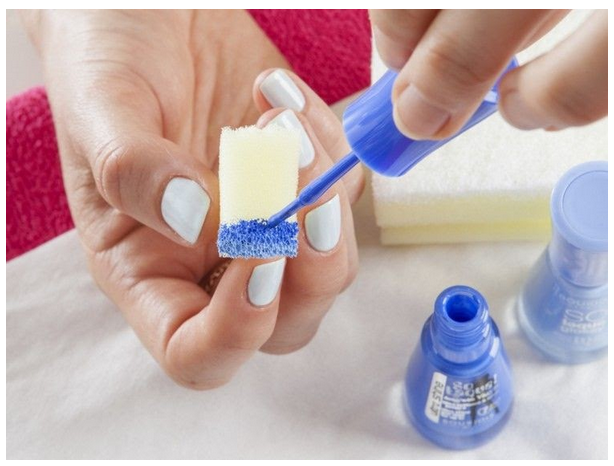
    Step 5: Using a makeup sponge, apply your ombré colors. 

    Using a tiny makeup sponge, paint your ombré colors in straight, horizontal lines side by side. The area of the sponge that you paint with should be around the same width as your nail. Begin by drawing a line across the width of the sponge with the lightest nail polish color. Then, below the first color, paint with the next darkest color. Finally, apply the deepest polish color beneath the second line of polish. Make certain that all of the colors are painted adjacent to one other, with no visible sponge between them. For each color, apply a couple coats of polish on the sponge so that the polish is wet enough to print onto your nail.

    • The ombré effect is often created with two or three colors, but you may experiment with other colors and combinations to find what you like most.
    • It may help to wet the makeup sponge first before applying the colors. Fill the makeup sponge halfway with water. Wring out the sponge until about 80% of the water has been gone. Then, using the nail polish colors, paint on the nails.

    Step 6: Apply the polish to your nails using a stamping technique.

    Stamp the polish onto your nail by repeatedly pressing the sponge (with the polish side down) on top of your nail, taking the sponge away every couple of stamps to see if the ombré is dark enough and to your preference.

    Step 7: Apply the nail polish on your nails. 

    Roll the paint onto your nails by pressing the sponge’s side edge on the side of your nail. Gently slide the sponge (with the polish side down) across your nail to the opposite side. Repeat to deepen the polish colors and enhance the ombré effect.

    • This procedure will cause some nail paint to be transferred to the skin around your nails. To avoid this, apply a thin coating of petroleum jelly to the skin around your nails or apply tape to the skin around your nails. Otherwise, you can wipe the sides of your nails afterwards using nail paint remover.
    • There is a lot of flexibility in how you apply the color to your nail. To create your ombré effect unique and distinctive, modify the location of the sponge (stamping vertically on the length of your nail, tilting the sponge to particularly stamp on a specific hue).

    Step 8: Fill the sponge with nail polish. 

    After you’ve completed the ombré effect on one nail, refill the polish onto the sponge to keep the ombré colors moist and bright. Paint the nail polish colors in the same order as previously, starting with the lightest and working your way down to the darkest. Make sure that all of the polish colors are blending well with each other.

    • Keep in mind that if you try to ombré your nails with a sponge that isn’t sufficiently dampened with paint, the dry sponge will actually peel off your base color coat and damage your varnish.
    • If you stamp or roll your nails fast, you’ll probably only need to add polish to the sponge every other nail.

    Step 9: Finish with a topcoat. 

    After you’ve given all of your nails enough time to dry (approximately 10-15 minutes), apply a top layer of clear polish to them. Because sponging creates a stippled and rough appearance on your nails, you may want to apply two layers of top coat to smooth them out.

    Step 10: Make sure the skin around your nails is clean. 

    Swipe a tiny paintbrush or Q-Tip soaked in nail polish remover around your nails’ edges and cuticles.

    • The cotton on the Q-Tip will aid in the removal of polish from the skin, whilst the paintbrush will be more precise in removing extra nail polish.

    How to do ombre nails by using a nail brush

    The first 3 steps are the same as when you do ombre nails by using a sponge.

    Step 4: Apply the 2 colors polish

    If you’re going straight to your natural nails, start by applying and curing your base coat; if you’re using extensions, jump right to the color. Apply your first color shade from the base of your nail to about halfway up the nail. Then, take your lighter polish and apply it to the remaining half of the nail, carefully pushing the deep color up to meet the light polish.

    Step 5: Blend the colors together

    Take your nail brush with you. To get this look, use a brush with thin, wispy hairs to create the perfect faded appearance; ombré brushes are available for purchase for this reason. To begin blending the colors together, carefully tap the transition line between the two tones with the brush. Cure this layer with your UV or LED lamp. To get the ideal, gradual ombré look, repeat the previous process, applying your two colors and softly pressing your brush from side to side.

    Step 6: Apply a transparent layer and top coat

    Use a slightly more translucent paint to apply another layer on your nail. After applying and curing, paint the top coat to make sure that everything stays in place.

    Frequently asked question about how to do ombre nails

    Q: Can I do ombre nails with regular polish?

    A: Of course! We recommend you use regular polish with the sponging technique but gel polish when using the nail brush.

    Q: How can I remove the extra nail polish off my skin?

    A: Once your nails are dried, wash it off. You may need to massage a little. You could also soak a q-tip in nail polish remover and wipe away the excess nail polish.

    Q: Where can I get a sponge like the one in this article?

    A: The sponge they’re using here is a cosmetics sponge (or cosmetic wedge), which you can find anywhere beauty products are sold. Some dollar/pound stores could have these too. You may use any sponge, although ones with air bubbles will provide a less smooth finish.

    Summary

    Going to a nail salon is comparable to doing ombre nails at home. You should have a pleasant time doing this if you have the right equipment and the patience to learn.

    Because each of the steps we listed is essential, you should finish them all without skipping any of them. If getting your ombre nails done is too difficult, you can come to Rachel’s Nails for it. We apply ombre nails with professional polish and specific equipment, and then apply a nail treatment coating on top of your nails. Rachel’s Nails offers not only manicures but also pedicures and cosmetic treatments.

    Every time you visit our nail salon, you will be served by expert nail technicians. We want to make sure that when consumers visit Rachel’s Nails salon, they get the best experience possible. Everyone can afford our prices. Aside from that, we provide high-quality products and services. We are located at 12a Norcot Road, Reading, UK. Here is our website https://rachelsnails.co.uk/ and you can read our blogs to get more information about nails.

    We hope that you find this article helpful and you can follow the tutorial about how to do ombre nails at home quick and easy.

For last minute appointments or booking issues please direct call our number 07402286286.